Geiko, maiko and geisha
Geiko vs maiko vs geisha, explained
Geiko, maiko or geisha? What each word means, how to tell them apart, the myths, and Gion's street rules, checked against Kyoto's own tourism pages.
Check dates and availability ↗Quick answer
A geiko is a geisha. Geiko is the word used in Kyoto and Kanazawa for a professional performer trained in traditional dance, music and song, who also hosts guests at banquets called ozashiki. A maiko is her apprentice, usually aged 17 to 20. You can tell a maiko by her own styled hair, long sleeves, red collar and a dangling obi 6 to 7 metres long. Around 20 or 21 she graduates in a ceremony called erikae and becomes a geiko.
Three ways to see a geiko or maiko
| Public odori | Gion Corner | Gion dinner | |
|---|---|---|---|
| When | Spring, plus November | Daily, 18:00 or 19:00 | Evenings, about 3 hours |
| Who performs | Geiko and maiko | Maiko, plus six other arts | One geiko or maiko |
| Talk to her? | No | No | Yes, for 2 hours |
| Best for | A full company on stage | A short first look | Questions and games |
What a geiko is
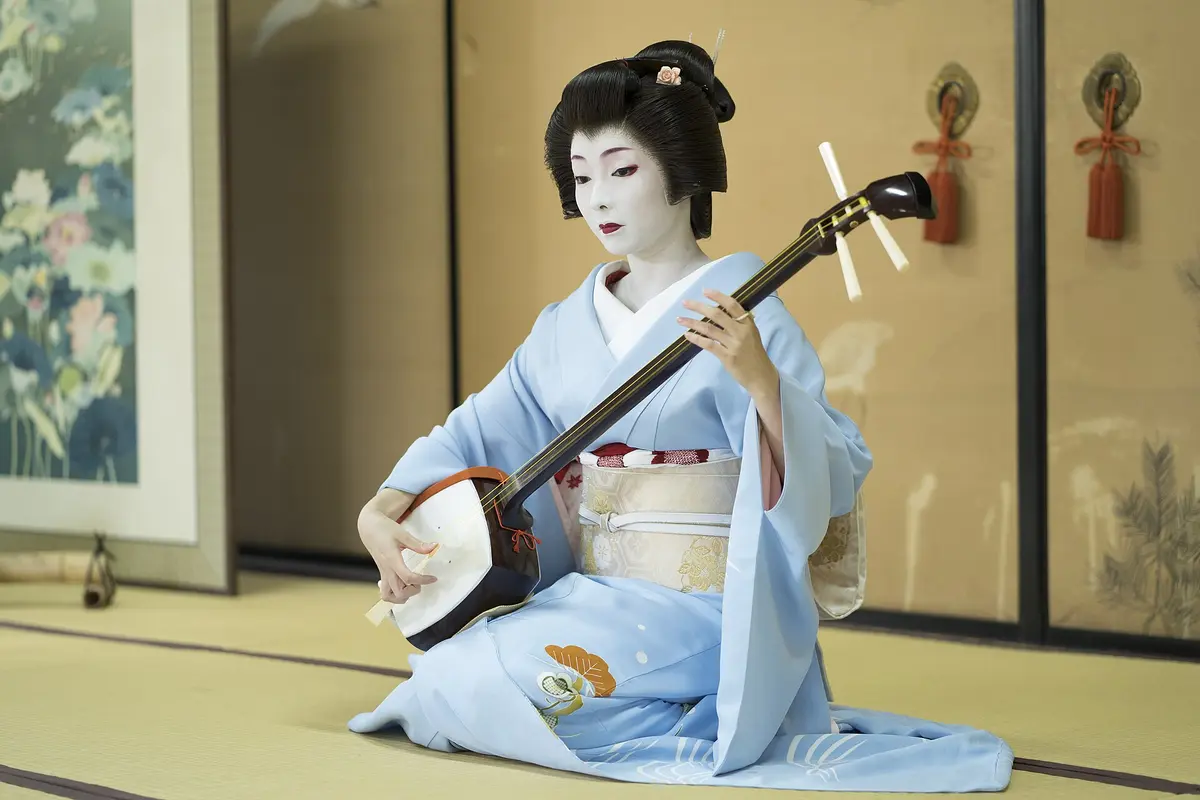
Geiko is the word Kyoto uses for geisha. It's the term in Kyoto and Kanazawa, and it translates as 'woman of art', while geisha means 'person of the arts'. The job is the same: a professional performer trained in traditional dance, music and song, and a skilled conversationalist and host. Geiko entertain at banquets called ozashiki, usually in a teahouse (ochaya) or a traditional restaurant, and they also perform on stage and at festivals. The women in Kyoto call themselves geiko, not geisha, so it's the better word to use while you're there.
Geiko vs maiko: how to tell them apart
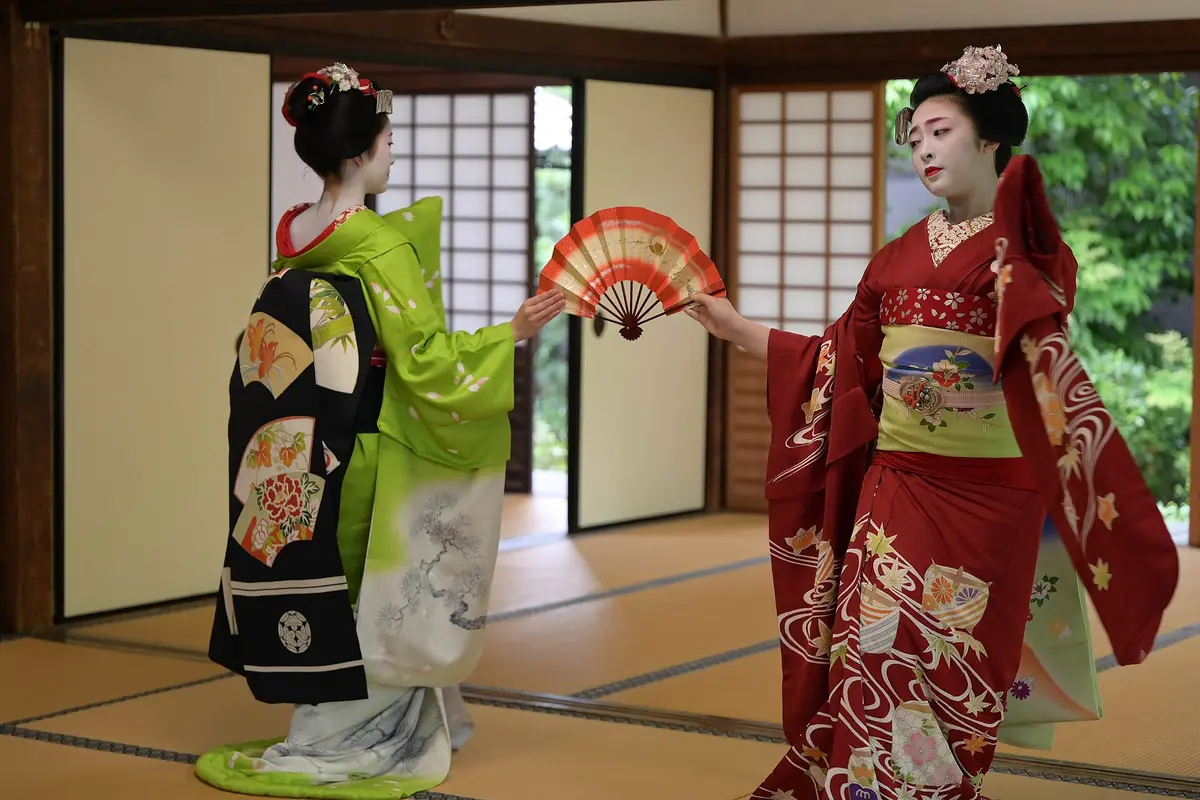
A maiko is an apprentice geiko, and in Kyoto the two are dressed to be told apart. Maiko are usually 17 to 20. Most wear their own hair, restyled every week, and sleep on a raised wooden pillow called a takamakura to keep its shape. Their kimono has long sleeves, the red collar of the under-kimono shows at the neck, and a darari obi 6 to 7 metres long hangs down the back. Only maiko wear it. A geiko usually wears a wig, a short-sleeved kimono and an ordinary-length obi. As she gets older she may stop wearing the white make-up except on stage.
- Hair: a maiko's own, with seasonal kanzashi; a geiko's is usually a wig
- Sleeves: long for a maiko, short for a geiko
- Obi: the dangling darari is for maiko only
- Collar: a maiko's shows red; graduation is called erikae, 'turning the collar'
From newcomer to geiko
Most women now begin after high school or even college. Labour law sets 18 as the age to join an okiya, the house every geiko must be registered to, though Kyoto okiya may legally take recruits at 15 to 17. A newcomer first lives there as a shikomi, often for up to a year. Then comes minarai, about a month of sitting quietly at banquets to learn by watching. Her debut, misedashi, makes her a maiko. Lessons follow in shamisen, flute, drums, song, dance, tea ceremony and calligraphy, plus the Kyoto dialect. Around 20 or 21 she graduates in the erikae ceremony.
Read next: From Maiko to Geiko: The Years of Training
Not courtesans: where the myth comes from
The profession has been mostly forbidden from being paid for sex since it began. Early edicts kept geisha apart from the licensed courtesans, the oiran, whose highest rank was the tayū. Some geisha did sell sex in the past, by choice or under coercion, and the Prostitution Prevention Law of 1956 outlawed practices such as mizuage. The Western image owes much to the occupation after 1945, when some prostitutes working for foreign troops called themselves 'geisha girls'. Then came fiction. Arthur Golden interviewed Mineko Iwasaki, a former Gion geisha, for Memoirs of a Geisha. She later sued him, settled out of court, and published her own life story in 2002.
The danna, then and now
A danna is a patron. In the past an established geisha might take one: usually a wealthy man, sometimes married, who paid her expenses, bought her gifts and had a more personal relationship with her than a banquet allows, at times a sexual one. It showed off his wealth and status, because a geisha's costs were high. Today it's much less common, mostly because few men can afford to support both a household and a geisha's living costs. It sits entirely outside the banquet. Guests at an ozashiki pay for an evening of performance and conversation, and clients know nothing more is expected.
How many are left, and where they work
Japan had as many as 80,000 geisha before the Second World War. In Kyoto the count fell from 548 geiko and 76 maiko in 1965 to 202 geiko and 71 maiko in 2006. They work in five districts, the hanamachi or 'flower towns': Gion Kobu, Gion Higashi, Pontochō, Miyagawa-chō and Kamishichiken. Gion holds two of them, Gion Kobu and Gion Higashi, which split in 1881. A geiko generally works only in her own district. Bookings still go through the okiya's mother and the district's registry office, the kenban, which keeps her schedule.
Gion's street rules
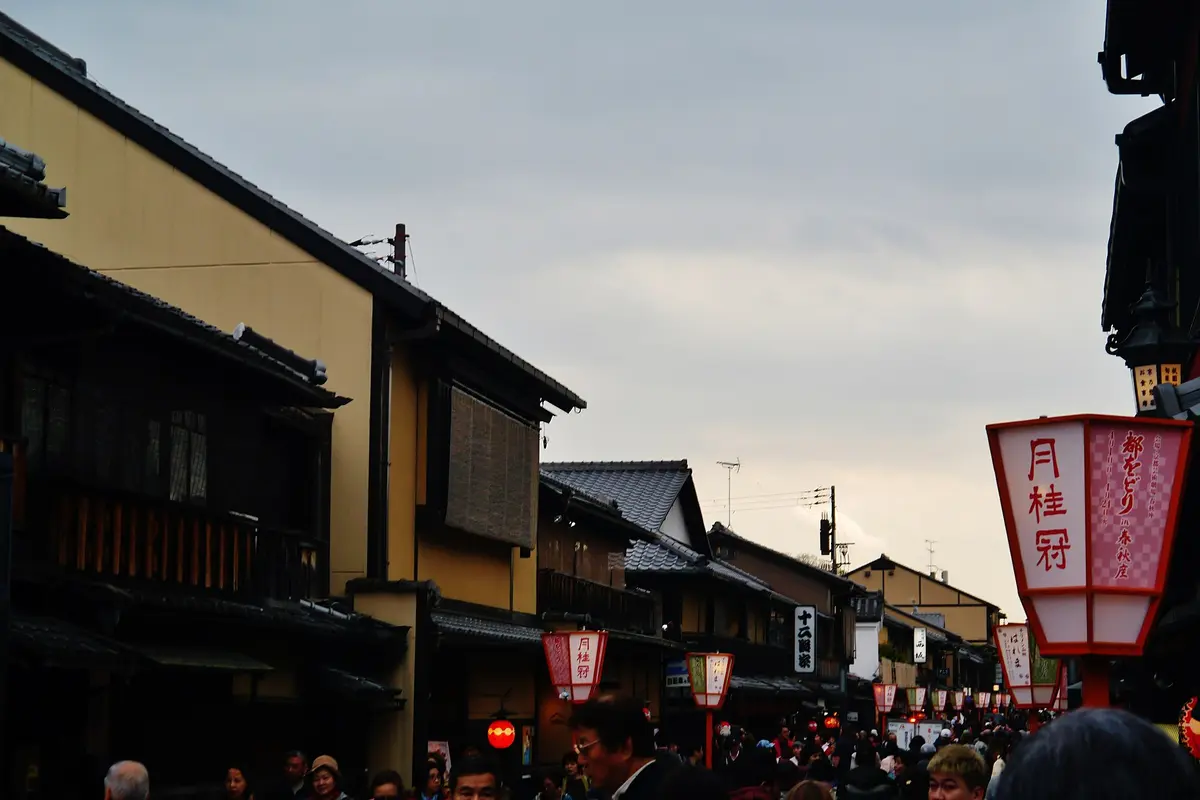
Southern Gion's residents' council, with the Gion Kobu teahouses, the Gion geiko association and Kennin-ji temple, publishes the district's rules on Kyoto's official tourism site. The first rule is about geiko and maiko: don't stop, touch or follow them, and don't photograph or film them without permission. As the council puts it, they aren't mascot characters. In 2019 Gion's council put up signs banning photography on private roads, with a warning of fines. In 2024 it said it would also ask visitors to stay out of the narrow private alleys. Hanamikoji, the main street, is public and stays open.
- Obstructing or stalking someone can mean detention or a fine
- Pulling someone's hand or clothes can mean up to six months in prison
- Private property, meaning anywhere other than shops and roads, is off limits without permission
- Don't stop in the road for photos: these streets aren't pedestrian-only
Read next: How to Be a Good Guest at a Geiko Dinner
Ways to see or meet a geiko
Traditionally you needed an introduction and connections to be entertained by geisha, and today's public options are the exception. Every Kyoto district holds an annual dance, or odori: Kitano Odori from 20 March to 2 April, Miyako Odori through April, Kyō Odori in early to mid-April, Kamogawa Odori from 1 to 24 May, and Gion Higashi's Gion Odori from 1 to 10 November. Gion Corner, in Gion Kobu, runs an hour-long show of seven traditional arts, in which maiko perform the Kyomai dance. You watch both from a seat. To talk to a geiko or maiko, you need an arranged dinner.
What the Gion geisha dinner includes
The evening we link to is run by Travel Japan Together and lasts about three hours, with a live guide in English. It starts at CACAO MARKET by MARIEBELLE KYOTO with a walk through Gion's streets, moves to a local restaurant for dinner, and finishes at a FamilyMart. Your host for two hours of private time may be a geiko or a maiko. She dances, plays traditional parlour games and talks with your group, and you can take photos with her. The dinner needs at least four participants. If a date doesn't fill, or your geiko or maiko becomes unavailable, you get a full refund.
- Included: a guided Gion walk with a local host
- Included: two hours of private time with a geiko or maiko
- Included: a premium multi-course kaiseki, mainly vegetables, fish and tofu
- Included: unlimited sake, with non-alcoholic drinks available
- Not included: extra food and drink
Who this isn't for
If you're a couple or travelling alone, you're relying on other guests: the dinner runs only with four or more, so a quiet date can be cancelled. If you only want to watch a dance, Gion Corner's one-hour show or a spring odori is the shorter option. If you tend to decide late, note that free cancellation ends 7 days before. If you don't eat fish, ask before you book, because the kaiseki is built mainly on vegetables, fish and tofu. And if you want a street photo of a maiko, Gion asks you not to try.
Frequently asked questions
What is a geiko?
A geiko is a geisha: it's the word used in Kyoto and Kanazawa, and it means 'woman of art'. She is a professional performer trained in traditional dance, music and song, and a host who entertains guests at banquets called ozashiki, usually in a teahouse or a traditional restaurant.
What is the difference between a geiko and a maiko?
A maiko is an apprentice geiko, usually aged 17 to 20. She wears her own hair, long sleeves, a red collar and a dangling obi 6 to 7 metres long. A geiko wears a wig, short sleeves and a standard obi. A maiko becomes a geiko around 20 or 21, in a ceremony called erikae.
Is a geiko the same as a geisha?
Yes. It's the same profession under its Kyoto name. Geisha, meaning 'person of the arts', is the general Japanese word, and Kyoto's geiko use their local term. Tokyo has its own word for apprentices, hangyoku, and its traditions differ from Kyoto's.
Are geisha prostitutes?
No. The profession has been mostly forbidden from being paid for sex since it began, and it was kept separate from the courtesans of the old pleasure quarters. Some geisha sold sex in the past, by choice or under coercion, but the 1956 Prostitution Prevention Law outlawed practices such as mizuage.
What is a danna?
A danna is a geisha's patron: traditionally a wealthy man who paid her expenses and had a more personal relationship with her than a banquet allows. It's much rarer today, largely because of the cost. It has nothing to do with being a guest at a dinner.
Can I photograph geiko and maiko in Gion?
Not without permission. Southern Gion's residents' council asks visitors not to stop, touch, follow, photograph or film geiko and maiko walking in the district, and its private roads carry no-photography signs. At an arranged dinner, photos with your host are part of the evening.
Sources
- Gion manner: message from Southern Gionmachi (Kyoto City Tourism Association)
- Gion Corner and the five districts' dances (Gion Kobu Kaburenjo)
- Gion and Higashiyama (Japan National Tourism Organization)
- Tourists banned from private alleys in Kyoto's geisha district (AFP via eNCA, March 2024)
- Geisha (Wikipedia)
- Mineko Iwasaki (Wikipedia)
- Maiko (Wikipedia)
- Gion (Wikipedia)